Inflammation, Endothelial Dysfunction, and Vasoplegia
Inflammation coordinates defense, repair, vascular behavior, and metabolism. During critical illness, those responses can become poorly matched to the location, intensity, or duration of injury. The resulting circulation may combine low arterial resistance, impaired venous return, leaky microvessels, obstructed regional flow, and altered cellular function. Understanding the separate mechanisms explains why neither an inflammatory marker nor a restored arterial pressure describes the whole process.
66.1 A phenotype describes the circulation before it explains the cause
Vasoplegia describes an inappropriate loss of vascular tone contributing to inadequate arterial pressure. It often accompanies low calculated systemic vascular resistance despite preserved or increased cardiac output. It is a physiological phenotype, not a molecular diagnosis. Infection, major surgery, ischemia–reperfusion, drugs, and other inflammatory or noninflammatory conditions can produce overlapping patterns.
Inflammation and vasoplegia are therefore related without being synonymous. An inflamed patient can have cold, poorly perfused tissue and low cardiac output. A patient with substantial vasodilation can simultaneously have myocardial dysfunction, reduced effective circulating volume, venous congestion, or vascular obstruction. None of these additional mechanisms is excluded by a warm skin examination or a rising vasopressor requirement.
Endothelial dysfunction is similarly broad. Endothelial cells regulate barrier properties, leukocyte interactions, vascular tone, and the interface with coagulation. One function can become abnormal while another changes in a different direction. Increased systemic dilation does not establish preserved endothelium-dependent regulation in every microvascular bed.
The distinctions become useful when an intervention changes one observation. An increased arterial pressure confirms a pressure response. Improved capillary refill supplies different information, and a falling cytokine concentration describes a changing blood measurement. None alone establishes correction of the entire inflammatory or circulatory disorder.
The appropriate causal sequence runs from initiating signals to cellular responses, then to vessel and organ behavior. At each stage, the question is what has actually been demonstrated. A laboratory perturbation may establish a pathway’s capacity to cause injury. A patient association may identify a prognostic marker. A randomized strategy tests the net effects of an intervention, including effects outside its intended target.
Chapters 16 and 21 develop the glycocalyx, filtration, and vascular contraction foundations. Here, those mechanisms are linked to host sensing, immune regulation, endothelial activation, heterogeneous perfusion, and the changing course of critical illness.
66.2 Host sensing recognizes microbial products and tissue damage
Innate immune cells and many tissue cells express pattern-recognition receptors. These receptors detect recurring microbial structures and signals released or exposed by injured cells. Their location matters: a molecule encountered at the cell surface, within an endosome, or in the cytosol can activate different signaling machinery.
Pathogen-associated molecular patterns include microbial lipids and nucleic acids. Lipopolysaccharide from Gram-negative bacteria is presented through accessory proteins to the MD2–Toll-like receptor 4, or TLR4, complex. Receptor activation recruits intracellular adaptors and transcriptional pathways, including nuclear factor κB, or NF-κB, and interferon-regulatory pathways. These programs change cytokine production, antimicrobial activity, adhesion molecules, and other cellular functions.
Poltorak and colleagues linked defective murine lipopolysaccharide responses to mutations in Tlr4. The affected animals resisted endotoxin effects while becoming more susceptible to Gram-negative infection. This establishes a crucial sensing pathway and illustrates why suppressing a damaging response can also weaken defense. It does not make TLR4 the sole receptor involved in human sepsis. 1
Damage-associated molecular patterns provide a sterile route into overlapping responses. Injured cells can release mitochondrial DNA, formyl peptides, extracellular ATP, and other signals. Zhang and colleagues combined trauma observations with cellular and animal experiments showing that mitochondrial products can activate neutrophils and produce remote inflammatory injury. These findings support a mechanism connecting tissue disruption to systemic inflammation, rather than a diagnostic test distinguishing every infection from sterile injury. 2
Some cytosolic sensing pathways assemble inflammasome complexes. These can activate inflammatory caspases that process cytokine precursors such as pro–interleukin-1β, while linked pathways can promote inflammatory cell death. Transcribing a cytokine precursor and releasing its active form are consequently distinct steps.
The response depends on the signal’s amount, location, duration, and the receiving cell’s prior state. Identical circulating concentrations need not produce identical tissue responses. A list of possible mediators is therefore less informative than tracing which cells encountered which signal and what they did next.
66.3 Amplification, restraint, and impaired defense can coexist
Cytokines and chemokines transmit information between cells. Some increase local vascular permeability and recruit leukocytes; others influence fever, acute-phase protein synthesis, metabolism, and the intensity of further immune activation. Complement and other plasma systems add amplification through partly overlapping routes.
An initially local response helps concentrate defense near a threat. Endothelial adhesion molecules slow and retain leukocytes, while chemokine gradients guide migration into tissue. Activated cells can release oxidants, proteases, and additional mediators. These products help control microbes but can also injure nearby cells and barriers, releasing further damage signals.
Restraint begins during activation. Receptor desensitization, inhibitory signaling, anti-inflammatory mediators, and removal of dying cells limit continued stimulation. These mechanisms can protect tissue, yet excessive or persistent suppression may reduce the capacity to respond to a subsequent infection. A weak response to a standardized laboratory challenge is different from a low circulating cytokine concentration.
In a rapid-postmortem study, Boomer and colleagues found impaired stimulated immune responses, altered inhibitory signaling, and immune-cell depletion in tissues from patients who died with sepsis. The findings establish important human evidence of impaired defense in that selected population. Differences in illness, age, treatment, and control tissues prevent treating the study as a universal trajectory for survivors or every stage of sepsis. 3
The clinically relevant model is not a compulsory early inflammatory phase followed by a separate late suppressed phase. Different cell populations and organs can occupy different states at the same time. Persistent inflammatory injury can coexist with poor antigen presentation or impaired leukocyte responses. Recurrent infection, tissue damage, and treatment can change the balance again.
Time must therefore be part of the explanation. A measurement obtained after days of illness reflects prior exposures and adaptation as well as current stimulation. Falling fever or lower cytokines may accompany recovery, altered treatment, or impaired responsiveness. The associated organ and immune-function evidence determines which interpretation is plausible.
66.4 Endothelial activation changes adhesion and the vascular barrier
The endothelium senses circulating mediators, microbial products, oxygen conditions, and mechanical forces. Activation changes gene expression and the release or presentation of stored molecules. Leukocyte adhesion, permeability, vascular signaling, and coagulation-related functions can consequently change together.
NF-κB helps translate inflammatory stimulation into expression of adhesion molecules and other effectors. In mice with selectively inhibited endothelial NF-κB signaling, Ye and colleagues observed less endothelial activation and organ injury in experimental sepsis. The cell-specific manipulation supports a causal endothelial contribution under those conditions; it does not establish that systemic blockade of the same transcriptional pathway is beneficial or preserves host defense in all settings. 4
Barrier function depends on endothelial junctions, the actin cytoskeleton, surface structures, and organ-specific anatomy. Vascular endothelial cadherin, or VE-cadherin, helps connect neighboring endothelial cells. Changes in junctional organization and actomyosin tension can open pathways between cells. This endothelial contraction affects barrier geometry; it is distinct from vascular smooth-muscle contraction that narrows the vessel lumen.
The angiopoietin–Tie2 system participates in endothelial stability. Angiopoietin-1 generally supports Tie2-associated barrier protection, while increased angiopoietin-2 can destabilize that balance under inflammatory conditions. Parikh and colleagues combined human sepsis observations with endothelial-cell and mouse experiments supporting angiopoietin-2-related barrier disruption. The experimental perturbations support mechanism, while the patient concentrations remain associations rather than a demonstrated treatment-selection rule. 5
Increased fluid and protein passage promotes interstitial edema when filtration exceeds lymphatic removal. Organ dysfunction then depends on tissue location and drainage as well as leakage: lung edema impairs gas exchange, while edema in a constrained compartment can raise tissue pressure and impede perfusion.
Activated endothelium also changes its relationship with platelets and coagulation proteins. Adhesion, inflammation, and local thrombus formation can reinforce one another, but permeability and thrombosis are not interchangeable measurements. Chapter 67 develops the coagulation and microvascular-thrombotic pathways in detail.
66.5 Glycocalyx disruption changes the blood–tissue interface
The glycocalyx and its associated endothelial surface layer form a hydrated interface containing proteoglycans, glycosaminoglycans, and bound plasma constituents. This interface influences cell adhesion, molecular access, mechanical signaling, and filtration alongside endothelial junctions and other barriers. It is not a uniform coating with identical functions in every organ.
Inflammation can activate enzymes and oxidant pathways that alter surface components. Loss or rearrangement can expose adhesion sites and change interactions between circulating cells and endothelium. Shed fragments may themselves enter the inflammatory environment, so structural disruption and signaling can become coupled.
Schmidt and colleagues used intravital microscopy and other experiments to show pulmonary heparan-sulfate loss and increased neutrophil adhesion during murine endotoxemia. Heparanase-related interventions modified those responses in the model. This is evidence for a specific pulmonary inflammatory mechanism, not proof that all vascular leakage is caused by glycocalyx loss or that a corresponding human therapy improves survival. 6
Human shedding measurements answer a different question. Steppan and colleagues found increased circulating glycocalyx-related markers in patients with sepsis and after major abdominal surgery. The findings support a circulating signature of vascular stress, but concentrations do not directly measure the amount of functional surface remaining throughout the body. 7
Edema also depends on microvascular pressure, effective oncotic gradients, hydraulic conductivity, interstitial mechanics, and drainage. A rise in vascular pressure can increase filtration through an already abnormal barrier. Conversely, reducing circulating volume can impair perfusion without correcting the barrier lesion. The revised Starling relationships in Chapter 16 explain why these mechanisms cannot be reduced to an assumption that all infused fluid immediately leaks out.
Recovery likewise requires restoration of cellular and surface function over time. A lower plasma shedding marker can reflect reduced release, changed distribution, or removal. It does not independently demonstrate rebuilding of the glycocalyx or restoration of organ-specific permeability. The useful interpretation connects the molecular measurement with circulation, edema, and tissue function.
66.6 Nitric oxide has local protective and systemic dilating effects
Nitric oxide, or NO, is generated from arginine by nitric oxide synthase enzymes. Endothelial NO production normally participates in local vascular regulation and interactions with platelets and leukocytes. Inflammatory signaling can induce additional NO production in several cell types, including vascular and immune cells. The distribution and timing of production matter as much as a whole-body estimate.
NO diffuses into nearby vascular smooth muscle and activates soluble guanylate cyclase. This increases cyclic GMP and downstream signaling that lowers calcium-dependent contractile activation and favors relaxation. Widespread activation can reduce arterial resistance and venous tone, contributing to hypotension and altered filling conditions.
The pathway is not simply absent before inflammation and switched on afterward. In a rat endotoxin model, Szabó and colleagues found early NO-associated vascular hyporeactivity before widespread inducible synthase activity was established, followed by later enzyme induction. The experiment demonstrates changing mechanisms within one model, not a clock defining human vascular phases. 8
Oxidative chemistry complicates the picture further. NO can react with superoxide to form peroxynitrite, linking inflammatory oxidant production to protein modification and cellular injury. At the same time, local loss of biologically available endothelial NO can impair regulated dilation. Increased production somewhere in the circulation does not mean that every region receives an appropriate NO signal.
This spatial distinction resolves an apparent contradiction: systemic vasodilation can coexist with impaired local endothelial function and restricted microvascular flow. Blood nitrate or nitrite concentrations cannot map these tissue-specific conditions or isolate one synthase source.
The pathway’s normal functions also explain why raising pressure by broadly suppressing NO need not improve the patient. Reduced dilation may increase cardiac afterload or remove local perfusion support. Demonstrating that NO contributes to hypotension is therefore different from demonstrating that global inhibition produces a favorable clinical balance.
66.7 Adrenergic responsiveness depends on the entire contractile pathway
An α₁-adrenergic stimulus normally recruits receptor-linked signaling, intracellular calcium release, calcium entry, and activation of the calcium–calmodulin–myosin light-chain kinase sequence. Myosin phosphorylation permits force generation. The resulting vessel caliber also depends on calcium sensitivity, opposing relaxant signals, transmural pressure, and passive wall properties.
Inflammation can weaken the response at several levels. Receptor expression or coupling may change, but signaling beyond the receptor can also favor relaxation. A drug can therefore reach and activate its receptor without generating the previous amount of contractile force. A higher infusion requirement does not measure receptor number or demonstrate a single form of desensitization.
In septic rats, Hollenberg and colleagues demonstrated reduced resistance-arteriole responses to norepinephrine and restoration of responsiveness with local NO-synthase inhibition. The experiment supports a downstream NO-related contribution in that preparation; it does not establish a beneficial systemic inhibitor strategy in humans. 9
Membrane electrical behavior provides another route. Opening potassium channels makes the smooth-muscle interior more negative, reducing activation of voltage-dependent calcium entry. ATP-sensitive potassium channels connect metabolic conditions to this process. Landry and Oliver demonstrated channel-related hypotension in experimental canine endotoxemia and hypoxic lactic acidosis, with model-specific reversal after channel blockade. The result establishes a possible mechanism, not an approved human treatment principle. 10
Acidemia, temperature, electrolyte conditions, endocrine signals, and prolonged catecholamine exposure can modify these pathways and cardiac performance. Their effects vary between vascular beds and preparations; no single pH or inflammatory-marker value establishes that all constrictor responses have failed.
The observed pressure response includes the heart and venous circulation as well. Increasing arterial tone can raise afterload while venous constriction recruits filling. Whether output increases depends on ventricular reserve and useful preload. Verifying drug delivery and measuring the integrated response are therefore necessary before assigning an unexpected change to molecular “resistance.”
66.8 Arterial resistance and venous capacity affect different parts of flow
Arteriolar dilation reduces the resistance opposing forward flow. Venous dilation increases the capacity of vascular reservoirs, allowing more blood to be accommodated without generating the same pressure for venous return. These processes can coexist but should not be combined into one undifferentiated statement about low pressure.
Loss of useful stressed volume can reduce cardiac filling even when total body fluid is abundant. Increased permeability and renal retention can simultaneously produce interstitial edema. A patient can consequently have swollen tissues, inadequate effective preload, and a low arterial resistance without these findings being mutually exclusive.
Systemic vascular resistance, SVR, summarizes pressure and flow. With mean arterial pressure, MAP, and central venous pressure, CVP, in mmHg and cardiac output, CO, in L/min:
For a constructed state with MAP 62, CVP 10, and CO 8, SVR is 80 × 52/8 = 520 dyn·s·cm⁻⁵. In a later state with MAP 77, CVP 12, and CO 5, SVR is 80 × 65/5 = 1040. Calculated resistance has doubled while output has fallen and arterial pressure has risen.
This does not establish that the pressure rise was unnecessary or that constriction caused the output fall. It shows why pressure response and flow response must be measured separately. Changes in ventricular function, venous return, ventilation, and treatment can all contribute. The calculation also inherits measurement errors and does not identify resistance inside each organ.
Fluid responsiveness asks whether increased filling produces more flow. Fluid tolerance asks what that additional filling does to venous pressure, lung water, and other organs. Neither is determined by the presence of inflammation or a glycocalyx marker. Further volume can improve useful preload in one state and mainly worsen congestion in another. The current limiting mechanism, rather than the inflammatory label alone, determines the likely response.
66.9 Low aggregate resistance can coexist with restricted regional flow
The circulation is a network of parallel and branching pathways. Different territories can develop different changes in tone, obstruction, pressure, and tissue swelling. A low global resistance therefore cannot establish that every region is dilated or adequately supplied.
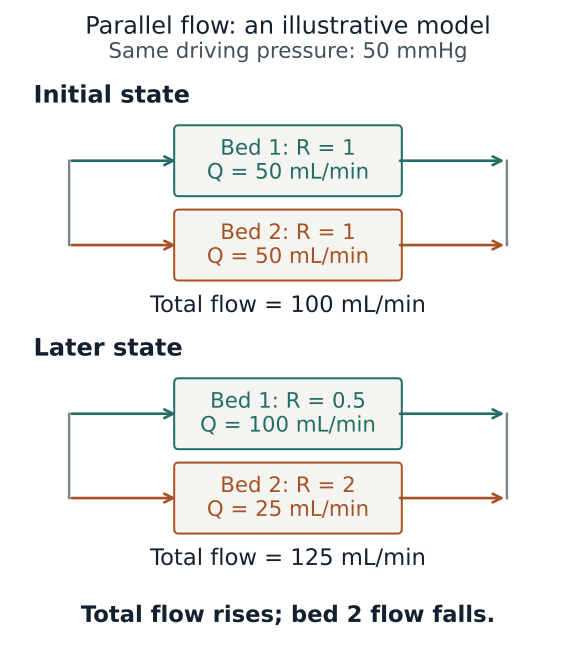
A deliberately simple parallel-bed model makes this visible. Let both beds have the same driving pressure difference, ΔP, in mmHg. Let each resistance R be expressed in mmHg per mL/min, and flow Q in mL/min:
Assume ΔP is held at 50 mmHg. Initially, both resistances are 1, giving flows of 50 and 50 mL/min and total flow 100. If resistance in the first bed falls to 0.5 while the second rises to 2, their flows become 100 and 25. Total flow rises to 125, yet flow through the second bed has halved. Aggregate resistance falls from 50/100 = 0.5 to 50/125 = 0.4 in the stated resistance units.
These are arbitrary model parameters, not organ-flow targets. They isolate the logic of heterogeneity; real capillary networks also involve changing downstream pressure, erythrocyte distribution, leukocyte interactions, and diffusion distances. Regions with interrupted or intermittent flow may extract oxygen poorly even while total cardiac output is high.
De Backer and colleagues directly imaged altered sublingual microvascular perfusion in patients with sepsis, with more severe abnormalities in nonsurvivors. The findings demonstrate human microcirculatory disturbance and an outcome association. A small accessible mucosal field does not measure all organ beds, and the association does not prove benefit from targeting a particular microvascular score. 11
A systemic pressure increase can improve a pressure-limited territory without correcting adhesion, obstruction, or barrier dysfunction elsewhere. Conversely, increasing constriction may redistribute flow unfavorably. Microvascular and organ observations help determine the response that global measurements cannot resolve.
66.10 Immune metabolism and blood biomarkers require compartmental interpretation
Immune activation changes the use of glucose, amino acids, and oxidative pathways. Increased aerobic glycolysis can support rapid biosynthesis and effector activity even when oxygen is present. Later impaired responsiveness need not mean a simple return to a resting metabolic state.
Cheng and colleagues combined human profiling with cellular and animal experiments. Initial activation involved metabolic reprogramming, whereas leukocytes from selected patients with immunoparalysis showed defects in both glycolysis and oxidative metabolism. These findings connect immune function with metabolic capacity without measuring mitochondrial performance in every organ or establishing a universal treatment. 12
Systemic stress hormones, substrate availability, oxygen supply, drugs, and tissue injury interact with these changes. Lactate can rise through stimulated glycolysis as well as impaired disposal or inadequate oxygen supply. It cannot identify the immune cell responsible or independently diagnose mitochondrial failure. Chapter 70 develops organ bioenergetic failure in greater detail.
Blood biomarkers also require mass balance. For a simplified well-mixed compartment, let amount A be expressed in arbitrary units, volume V in liters, and concentration C in units/L:
If 300 units occupy 3 L, concentration is 100 units/L. Expanding the compartment to 4 L without changing amount gives 75 units/L, a 25% concentration decrease without any reduction in total amount. This is a constructed dilution example; actual mediators have release, transport, binding, and removal, and their apparent distribution volume need not equal plasma volume.
The same principle applies to cytokines and shed endothelial constituents. Their concentration reflects more than production, while removal can change with organ function. Different assays may measure different molecular forms. A falling result can accompany recovery but cannot by itself prove reduced pathway activity, restored barrier function, or a particular immune phenotype.
Useful biomarkers are tied to a defined clinical question and validated method. Prognostic association, mechanistic involvement, and ability to select an effective treatment are separate properties that require separate evidence.
66.11 Mechanism-directed treatment requires outcome evidence
Intervening on a plausible pathway changes more than its harmful effects. A receptor may participate in both defense and injury, and a vasodilator may contribute to hypotension while sustaining local flow. Consequently, restoring a pressure or lowering a mediator cannot substitute for testing the complete clinical strategy.
In the 797-patient trial of the nonselective NO-synthase inhibitor 546C88, 28-day mortality was higher with inhibition, and the trial stopped early. Cardiovascular adverse events contributed to the observed difference. The result does not negate NO’s role in vascular hyporeactivity; it demonstrates harm from that particular systemic inhibition strategy. 13
Blocking an upstream inflammatory receptor also requires clinical testing. ACCESS evaluated the MD2–TLR4 antagonist eritoran in a large severe-sepsis population and did not reduce 28-day mortality. That finding concerns the agent, timing, selection, and strategy tested; it does not establish that microbial sensing is irrelevant or that every future immune intervention must fail. 14
ImmunoSep tested a phenotype-directed approach, assigning anakinra or interferon gamma according to specified immune criteria. Of 281 randomized patients, 276 entered the primary analysis. The strategy improved its prespecified average SOFA-response endpoint through day 9 compared with placebo, while 28-day mortality did not differ significantly. This phase 2b result supports further evaluation of the defined strategy; its selected infections, assays, safety findings, and surrogate primary endpoint prevent extrapolation to universal biomarker cutoffs or a proven survival protocol. 15
These studies answer different questions and should retain those distinctions. Animal pathway inhibition, a human prognostic association, a physiological drug response, and a randomized organ-function endpoint are not interchangeable claims. Treatment evidence must also account for competing infection risk, cardiac load, regional perfusion, and the changing host state. A successful intervention is defined by the benefit demonstrated in the relevant population, not by the elegance of its proposed mechanism.
66.12 Interpret the evolving inflammatory circulation as a connected system
Consider the constructed states from Section 66.8. Initially, MAP is 62 mmHg, CVP 10 mmHg, and cardiac output 8 L/min. Later, MAP is 77, CVP 12, and output 5. The calculated SVR increase from 520 to 1040 describes the altered pressure–flow relationship; it does not independently measure endothelial recovery.
Assume arterial oxygen content remains 18 mL O₂/dL. One liter contains 10 dL, so initial global oxygen delivery is 8 × 10 × 18 = 1440 mL O₂/min. Later delivery is 5 × 10 × 18 = 900 mL O₂/min. A higher arterial pressure has accompanied a 37.5% delivery decrease, calculated as (1440 − 900)/1440 × 100.
The clinical meaning remains conditional. Improved driving pressure may help some organs, while reduced flow, increased venous pressure, or altered distribution disadvantages others. Consumption, extraction, regional blood flow, and tissue demand determine whether the delivery change produces oxygen limitation. Neither the initial high output nor the later higher pressure supplies that answer.
Suppose lactate falls while edema increases and a shedding marker decreases. Lactate can change through production and disposal; edema reflects filtration and drainage over time; the marker can change through release, distribution, and removal. This pattern is not intrinsically contradictory and cannot establish one causal story without further evidence.
The relevant reassessment examines infection and tissue-injury sources, actual drug exposure, arterial and venous pressures, measured flow, ventricular function, gas exchange, fluid balance, and regional organ findings. Immune and endothelial observations add biological context when their method and meaning are clear. They do not replace the circulation being examined.
Recovery may involve decreasing inflammatory stimulation, restoration of endothelial and smooth-muscle function, changing immune responsiveness, and resolving organ injury at different rates. The same support can consequently produce a different response later. A coherent interpretation follows these trajectories together while preserving the distinction between the observed phenotype, a plausible mechanism, a measured biomarker, and a treatment effect demonstrated in patients.
References
1. Poltorak A, He X, Smirnova I, et al. Defective LPS signaling in C3H/HeJ and C57BL/10ScCr mice: mutations in Tlr4 gene. Science. 1998;282:2085–2088. Original study.
2. Zhang Q, Raoof M, Chen Y, et al. Circulating mitochondrial DAMPs cause inflammatory responses to injury. Nature. 2010;464:104–107. Original study.
3. Boomer JS, To K, Chang KC, et al. Immunosuppression in patients who die of sepsis and multiple organ failure. JAMA. 2011;306:2594–2605. Original study.
4. Ye X, Ding J, Zhou X, Chen G, Liu SF. Divergent roles of endothelial NF-κB in multiple organ injury and bacterial clearance in mouse models of sepsis. J Exp Med. 2008;205:1303–1315. Original study.
5. Parikh SM, Mammoto T, Schultz A, et al. Excess circulating angiopoietin-2 may contribute to pulmonary vascular leak in sepsis in humans. PLoS Med. 2006;3:e46. Original study.
6. Schmidt EP, Yang Y, Janssen WJ, et al. The pulmonary endothelial glycocalyx regulates neutrophil adhesion and lung injury during experimental sepsis. Nat Med. 2012;18:1217–1223. Original study.
7. Steppan J, Hofer S, Funke B, et al. Sepsis and major abdominal surgery lead to flaking of the endothelial glycocalix. J Surg Res. 2011;165:136–141. Original study.
8. Szabó C, Mitchell JA, Thiemermann C, Vane JR. Nitric oxide-mediated hyporeactivity to noradrenaline precedes the induction of nitric oxide synthase in endotoxin shock. Br J Pharmacol. 1993;108:786–792. Original study.
9. Hollenberg SM, Cunnion RE, Zimmerberg J. Nitric oxide synthase inhibition reverses arteriolar hyporesponsiveness to catecholamines in septic rats. Am J Physiol. 1993;264:H660–H663. Original study.
10. Landry DW, Oliver JA. The ATP-sensitive K⁺ channel mediates hypotension in endotoxemia and hypoxic lactic acidosis in dog. J Clin Invest. 1992;89:2071–2074. Original study.
11. De Backer D, Creteur J, Preiser JC, Dubois MJ, Vincent JL. Microvascular blood flow is altered in patients with sepsis. Am J Respir Crit Care Med. 2002;166:98–104. Original study.
12. Cheng SC, Scicluna BP, Arts RJW, et al. Broad defects in the energy metabolism of leukocytes underlie immunoparalysis in sepsis. Nat Immunol. 2016;17:406–413. Original study.
13. López A, Lorente JA, Steingrub J, et al. Multiple-center, randomized, placebo-controlled, double-blind study of the nitric oxide synthase inhibitor 546C88: effect on survival in patients with septic shock. Crit Care Med. 2004;32:21–30. Original trial.
14. Opal SM, Laterre PF, Francois B, et al. Effect of eritoran, an antagonist of MD2-TLR4, on mortality in patients with severe sepsis: the ACCESS randomized trial. JAMA. 2013;309:1154–1162. Original trial.
15. Giamarellos-Bourboulis EJ, Kotsaki A, Kotsamidi I, et al. Precision immunotherapy to improve sepsis outcomes: the ImmunoSep randomized clinical trial. JAMA. 2026;335:775–786. Original trial.